
Image Credit https://www.pexels.com/photo/solo-hiker-enjoying-stunning-mountain-view-30784224/
Traveling never loses momentum in the context of the global economy, unless there is a global shutdown, of course. The abundance of travel podcasts, documentaries and books is an indicator that this lifestyle attracts perhaps most people. Recent numbers are encouraging too, indicating that tour operators expect 66% higher profit this year compared to 2024. I know many of them probably want to deal with big groups of people, or at least families, but solo traveling is crucial, and solo travelers are active as never before, and this is what we will examine this time.
Seriously, why travel alone when it actually is a better experience when shared with friends and loved ones? Perhaps one of the answers is that the modern world is becoming a great place for solo travelers, offering many more activities that are not as boring as some of the shared ones (sorry). In this article, we dive into 4 adventure types that attract solo travelers, who then set up the camera on their head, get into action, and share it later with their social media families.
Why some solo travelers want the cockpit, not just the view
Before delving into one of the most fascinating sports, it seems like providing a quality description from Britannica would be a good start. It is inserted below, but please pay attention to the highlighted part—we are talking about as early as 1914, when aero technology was far behind compared to today.
Today, a lot has improved, and aerobatic flying is living in an exciting era full of enthusiasts, both men and women, who seek the passion for not just adrenaline but something else too. In the podcast of Team Ignition Season 2, Emma McDonald, who is a pro in the field, talks about mastering precision. So, this activity has a broader appeal than one might think.
Solo travelers often talk about wanting experiences that pull them fully into the present. In this setting, attention narrows fast. A headset briefing, a steady climb, the first sharp change in angle, the pressure of a turn, and then a loop or roll that makes the horizon move in a way most people have never seen before. The appeal is not only speed. It is precision. Every move has timing, balance, and technique behind it, which gives the ride a kind of shape that feels memorable rather than random.
Aerobatic flying also works well as a solo activity because it removes the awkward middle ground that can happen on group excursions. There is no waiting for a crowd to get comfortable and no need to match another person’s pace. The focus stays on the flyer’s own response, which can make the experience feel both personal and unusually clear. Emma’s interview gives more insights, by the way, if you want to discover the whole nature of this breathtaking activity:
Skydiving turns strangers into a team in minutes
The numbers show how active and visible the sport remains.
| Skydiving snapshot, 2024 | Figure |
| Estimated U.S. skydives | 3,880,000 |
| Estimated skydives abroad | 1,290,000 |
| Estimated worldwide jumps | 5.1 million+ |
| Average skydives per member | 2,271 |
That blend of high volume and strong community (we talk about almost 4,000,000 skydives only in the US in one year) helps explain why solo travelers keep talking about skydiving long after the trip is over.
For many, the real draw is not just the jump. It is the clean emotional arc of the whole experience. There is anticipation, action, release, and then the rush of landing with a new kind of calm. Few activities compress that much feeling into such a short span, and that is a big reason skydiving keeps showing up in solo travel stories.
Scuba diving gives solo trips a different kind of depth
If skydiving is about sudden release, scuba diving is about settling into a new rhythm. That contrast is exactly why it belongs in the same conversation. Solo travelers are not always chasing noise or speed. Quite often, they want an experience that feels immersive, focused, and quietly transporting. Scuba diving does that better than almost anything else.
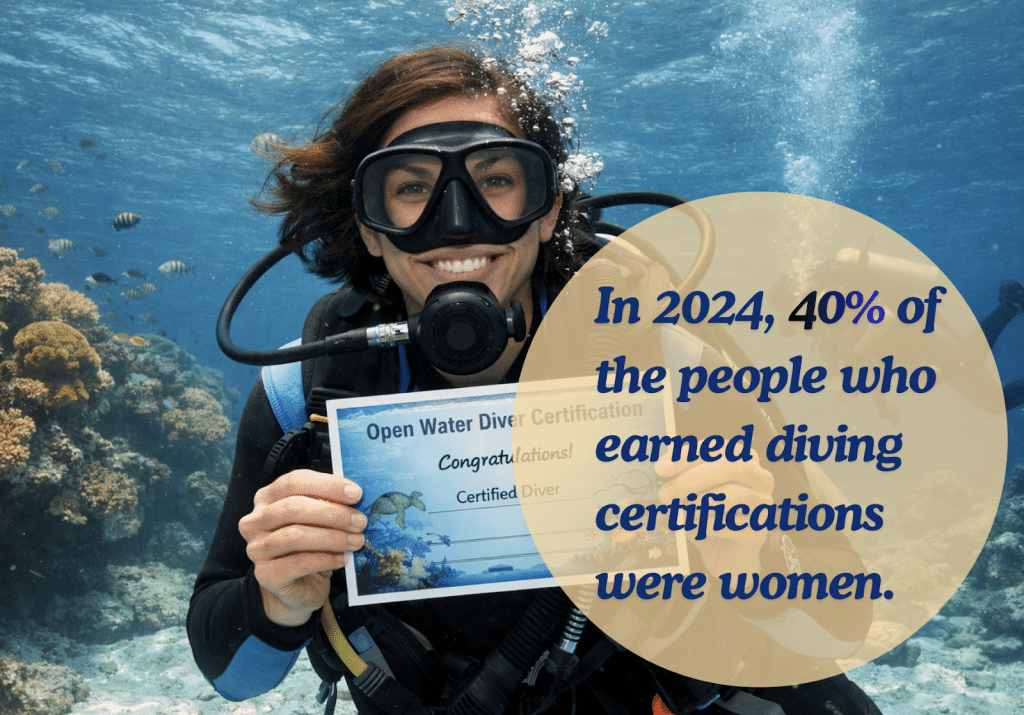
Young people were also a big part of it, with people under 30 earning about half of all certifications around the world.
Current certification patterns also suggest how wide the appeal has become.
The Asia-Pacific region was the most popular place for diving certifications. The top countries were:
• the United States,
• Thailand,
• Malaysia,
• Egypt,
• and the Philippines.
This shows that diving is now strongly connected to solo travel and to where people choose to go on their trips.
The emotional logic is different from other adventure activities. A dive day gives solo travelers structure without taking away independence. There is planning, a boat ride or shore entry, buddy checks, and shared excitement, but there is also long quiet focus once you are underwater. That mix can feel ideal when you want contact with other people, but not the constant pressure of being “on.”
As the iconic marine biologist Sylvia Earle once said, “Every time I slip into the ocean, it’s like going home.” This helps explain why many solo travelers love diving and feeling what professional divers and explorers feel every time going deep into the unknown. And although we as travelers describe the feeling as just an excitement, perhaps there more in that, connecting us to the nature.